

Crafted with passion
tejun Project management for everyone, not for project managers.
Tejun is a simple, human scale tool for the people other PM apps forgot: students writing a thesis, parents organizing a wedding, anyone trying to learn a language or launch something small. From idea to done.
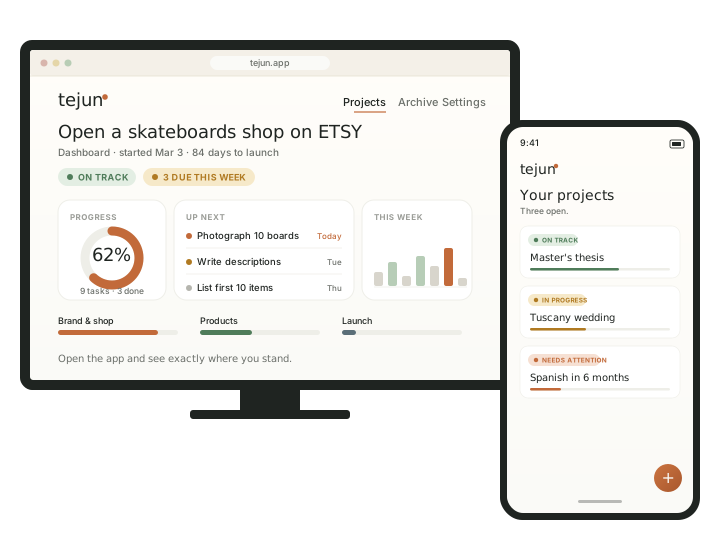
Most project tools assume you already know how to run a project
Jira, Asana, Trello, Monday. They're built for people who've sat through stand-ups, who know what a sprint is, who can read a backlog without flinching. Powerful, yes. But empty rooms for the rest of us.
And yet the projects that matter most in our lives, finding a new job, building a local charity, growing a side business, writing a book, are run mostly by people who have never been taught project management at all. They wing it. They forget steps. They burn out. The project gets done, but at far higher cost than it had to.
Tejun is for the people who have a project, but never learned how to run one.
Six steps. The same six, every time.
Tejun teaches a small, opinionated way of running a project: the same ideas I've been writing about for years, distilled into a flow you can follow without ever hearing the words "methodology" or "stakeholder matrix." At every step, a patient wizard walks beside you. From defining the first goal to closing the project, the app guides every phase of creation and management, so you always know what you are doing now and what comes next. No blank screens, no guessing.
- 01 Define the goal Write down what success actually looks like: concrete, measurable, time-bound. Tejun walks you through the questions.
- 02 Sketch the charter Who else is involved? What could go wrong? Three or four prompts now, revisited as a living document later.
- 03 Break it down Cut the project into smaller pieces. Don't aim for perfect. You'll refine it as soon as you see the timeline.
- 04 Draw the timeline Your whole project on one calm timeline. Drag, reorder, see what fits before the deadline and what doesn’t.
- 05 Run the project Open the app when you have five minutes. See where you are, what’s next, whether you’re on track. No nagging.
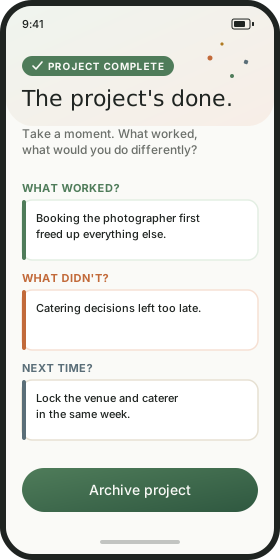
- 06 Close it well The project's done. Take a moment. What worked, what didn't, what would you do differently next time?
Simple by default. Patient by design.
Status colours instead of red alarms. A guide that speaks in the first person. White space where other apps would put a banner. Tejun is built to be opened on a Sunday evening with a cup of tea, not a stand-up meeting at 9:01.
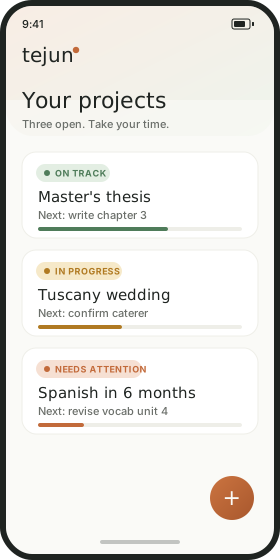
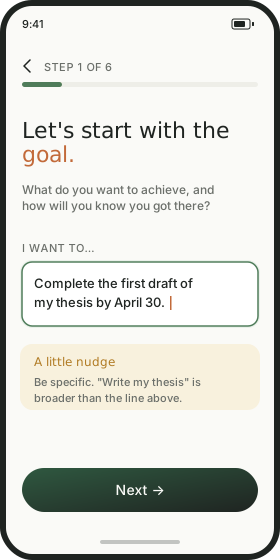
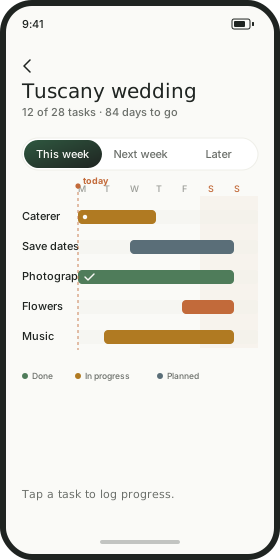
One engine, any project
Tejun is a single project engine that adapts to whatever you're building. The examples below are just common shapes, the same flow works for any project you bring.
And anything else. Tejun adapts to your project, not the other way around.
Why "Tejun"
Tejun is a Japanese word, 手順, that means "the steps you take, in order, to do something." Not the abstract plan. Not the strategy. The practical, embodied, do-this-then-this sequence of actually getting work done.
手 te means "hand." The same character is in karate (empty hand) and te-zukuri (handmade). Concrete, embodied, practical. Not abstract. 順 jun means "order, sequence: what comes after what," the character behind jun-ban (whose turn) and jun-jo (the proper order of things).
In Japanese business culture, the phrase tejun-dōri ("according to the proper procedure") is high praise. It means someone respected the work enough to do it in the right order. That, more or less, is what this app teaches.
You never plan alone
At every phase of a project a different guide meets you: to set the direction, shape the plan, keep things moving, watch how it is really going, and celebrate what you built. They speak in the first person, one step at a time, never in a hurry. Jun the Guide, Aiko the Planner, Kenji the Builder, Emi the Observer, and Yuki the Celebrator.
Free to use, EU-native by design
This is a side project, not a startup. There are no paid tiers, no premium features, no ads. Every server, every backup, every byte stays inside the EU. Frankfurt hosted, GDPR friendly by default, no third-party ad trackers, ever. The information you share inside Tejun is never read by anyone, not by other users, not by partners, not even by me.